Showing posts with label studies. Show all posts

Thursday, 16 April 2015

Francess Moffatt

In this lecture we were introduced to another successful local illustrator named Frances Moffatt, who specialises in fashion.

Frances Moffatt studied BA Hons Fashion Marketing and worked with assistant accessories design at Luella, received a PGCE and studied an MA in future design illustration. She realised she was more interested in fashion illustration in her final year of studying, which I think is quite inspirational as it assures us as students that it is okay not to know what we want to specialise in immediately. 


found here


She created this image 'Sunglasses girl' and included it within her MA portfolio where it was selected by New Talent and given national recognition, which was a huge turning point for her as an illustrator.

She then set her own website up, sending her work to book publishers, greetings card publishers (who were working for Marks and Spencers) and different magazines.

One of the publishers she had contacted was Batsford publishers, "a leading publisher in the areas of fashion, design and illustration, practical art, textile art, heritage and chess." 

They approached her roughly 18 months after she had sent her promotional mail out to them, showing us that we should not lose heart when contacting agencies.


She began to grow more interested in childrens fashion illustration and greetings cards, looking into these areas with more detail. 

Frances created many commission pieces whilst finding her feet in the industry, 35% of which went to the company she worked for for each: The Bright Agency, which is a company specialising in childrens illustration. This was a big stepping stone as it enabled her to become known in this area of the field and develop her confidence working on childrens fashion illustrations. 

She created some childrens sticker books which she claimed was hard work as it involved a lot of time and correcting. Her first published pieces appeared in Go-Girl Magazine (a magazine for young girls). 

Frances Moffatt uses the technique/process of creating her studies using pencil and ink, and then further editing her studies using Photoshop. I quite admire that the artist combines both traditional and nontraditional techniques to create her work, and it gives them quite a tidy and professional look as well as keeping the quirky feeling of them alive. As an artist, she prefers to be working with people rather than at home alone. 

Here is her working progress in order: 
  • Picture research
  • Pencil sketch
  • Draft layout in Photoshop
  • Awaiting approval
  • Ink in, create layout and tidy up in Photoshop
  • Submit work as PDF file


found here

She stated that being a student did mean that she had more time to put into her work. Frances also explained to us that it is hard to get work agreed upon as all agencies want different things, so it can take a lot of time before final images are reached. The process therefore requires patience and determination. 

Another company she was approached by was Paperlink Greetings Cards who create stunning occasion cards, however she disagreed with what they wanted and left them. It was then that she was approached by Batsford, who actually had already a specific project in mind for her. This was a childrens exercise book based on fashion illustration.   

her book


She used the same timely working process as described earlier to create this book, and it was the first project she really enjoyed. She found it a struggle to complete it because of the issue with time and money, but it was a huge success in the end. She had to take accurate measurements for the book and used typography by tracing over font in this product. 


Batsford Interview with Frances Moffatt. Frances exclaims that this company were a pleasure to work with. 

She holds stock lists with companies such as V & A, National Portrait Gallery, Tate, Baltic, Amazon, Waterstones, TK Max and Oliver Bonas. 

Frances Moffatt is currently teaching to earn her money. 

The whole journey she has been on up to now she feels as though has given her freedom in the creative industry. I found this lecture to be very inspiring. I strongly admire the work of this artist and as well as this I have took influence from knowing she did not always know which path to take on her way, but has found great success in the field and loves her job. I found her optimism very influential and have also took on board more ideas for potential careers for myself in the future. 

The pitch

Before we were given this lecture, we were asked to research the one of the individual printing techniques that are available to us to perform with as illustrators. We were to chose from the list of techniques which was given to us:

  • Risograph
  • Letterpress
  • Screenprinting
  • Etching
  • Lithograph
  • Anything else of our choice
We were asked to research the process of the technique as well as the ways it is used, the companies which specialise in this method, the cost of it and how other illustrators and designers use it. 

I had chosen to research the Etching technique, and had to prepare myself for later giving a pitch on this subject, with an aim to sell this technique to my peers and convince them that this was the best technique available to use. 

I found most of my research for Etching here.


What I discovered


The process:

When gathering my research on etching using the above site, I learned about both the original method and process for etching as well as the modern day techniques used. Throughout the original process, a metal plate was covered with a waxy drawing surface which is unreactive with acid. The study of the artists choice was then scratched into the ground (waxy surface) with a needle, exposing the metal beneath. A tool used throughout this process was an 'Echoppe' which was used to swell the lines and create different effects. The plate is then washed with acid, dissolving some of the metal and leaving in its place the original lines sunk into the plate. The remaining elements of the ground are then also cleaned away. The plate is then cleaned all over and wiped thoroughly, leaving ink behind in only the engraved lines of the drawing. The plate is then taken through the printing process with wet paper, which when pressed against the plate picks up the ink from inside the lines and makes the print appear. The use of the metal plate is of a high advantage to the artist who can then continue using it to create identical prints countless times before the metal is worn out. 
The process of etching is regarded as a form of monoprinting and can also be combined with the technique of engraving and aquatint. The method overall varies and there are many different techniques that can be used when etching. For example in our print room at university, we complete the process very similarly to that of the original, however we use more modern materials and the process has developed greatly over time. We are fortunate enough to have cheaper, safer and more efficient ways of creating etchings. 

Ways it is used:

Etching is used to create varied and detailed prints. It is a very beneficial process because it enables us to create varied lines and patterns. It can be used to capture things like photographs, portraits, detailed drawings or expression.

Companies specialising in that method of printing: 

A company that uses etching is The London Print Studio who also encourage people to join courses at their institute to practice the technique and learn more about it. I couldn't find any specific companies online which use the etching process regularly and sell etchings either alone or amongst other works, however I do not believe that this is actually the case, as the likelihood is there are many incorporations who use the printing technique of etching on a regular basis for their work. 

The cost:

After looking into the different elements of etching such as the materials (1 and 2) etc, I have learned that etching is quite affordable. I did not find an exact price for how much etching costs creators, however the materials are reasonably priced especially for their quality, and knowing we no longer have to use things such as metals and acids makes the expenses much more cost effective. Also, very many art based institutions across the world hold access to etching machines and materials meaning it is obviously not difficult to keep up with the prices of these. 

How illustrators and designers use it: 

Many artists over time and centuries use the etching process for their own individual uses. It has been used for newspapers, advertisements, posters and framed art works. Many artists use it like they would any other form of art, and use it simply to create masterpieces. 

Artist Rembrandt, famously used the technique of etching to create many of his works during the 1600s. I think that his creations are beautifully created and detailed, especially when considering length of time ago they were created. 

Image found here

We can see here that the artist has captured a particular scenario in this piece. I admire how the artist has used darkness and light in this image and also how the detail varies to create this, as well as an interesting composition. We can see how he has used varying lines in this study using the etching process to create bold and intricate marks.
Image found here


Here is an example of how etching can be used to create portraiture pieces. I think this is a stunning image and we can again see how the artist has varied the thickness in his lines. It has an ancient feel to it, however this is interesting because the techniques he has used are still very accessible to this day.
found here


Here is an example of how etching can be used to create landscape pieces. The artist has used different techniques in this piece to give varying textures which I think adds very interesting elements to the study. It also creates an incredible atmosphere and the detail he has managed to capture in this drawing is very inspiring. 


Many artists continue to use the technique of etching to this day. 


Unfortunately, I was unable to attend the lecture where I would have been able to pitch the information above I found when researching the technique of etching. I am hoping that there will be another opportunity to do this or something similar soon as I am aware that it is quite a crucial part of our development as it enables us to prepare for scenarios and situations we may face in our future careers as illustrators, if working for companies that rely on advertising in this way. 


I do also intend to practice etching much more in the future, having very limited experience with the process. I would also like to experiment further with the other printing techniques that are available for us to practice with at university, such as the ones I discussed earlier. I think that it is important to give each one a go and see where this could take me. 

Friday, 9 January 2015

People and characters

For our next major project on our course, we were given the opportunity to create a small exhibit within the folio gallery at our university, based on the theme of 'People and characters'. We were put into groups of five, (our group consisting of myself, Carly, Lucy, Kath and Lauren) and then together chose our own area of the folio that we would like to create our drawing installation onto.
To get our ideas flowing, and to begin getting used to the idea of drawing interesting characters, we were provided with a variety of workshops including life drawing sessions. I found to be very insightful towards this project because it allowed me to focus on a small variety of unique and intriguing characters.


Workshops and life drawing

The first workshop we were given was an outside life drawing session of a bearded man on a motorbike. I found it interesting to draw this man because of his outstanding qualities, and the fact that the man was sitting on his bike seemed to add a lot of story to the drawings. Here were some of my images from that session:
Concentrating on the face
Full page drawing
Experimenting with coloured pencil
Another session which I found helpful was when we were given the opportunity to draw another very interesting character called Chalky the Yorkie. I found this to be a really great session because it again let us focus on a quirky unusual person, and I felt more able to experiment with my media in this session because we were indoors:

fineliner sketch
Pencil sketch

Coloured pencil


Watercolours, graphite
Ink and watercolour
Watercolour, graphite, charcoal
and pencil.


Another life drawing session included a female model who was dressed very colourfully, from head to toe. This gave her very eye catching qualities and gave her a definite quirkiness. She appeared very lively and loud, and this gave away that she probably had a lot of personality. She was fun to draw because of this and as a group helped us to begin thinking of ideas to help us with our work. Here are some studies from this workshop:

coloured pencil

oil pastel

Pencil

Scribbly marks


Lying down


We were also given in one workshop the opportunity to revisit the nearby taxidermy, where they held lots of official photographs of Hartlepools past mayors. They had a great selection of photographs where the leaders were wearing old fashioned clothing. This, as well as the aged feeling to the images was a great inspiration to our work as it enabled us to begin properly forming our ideas for the exhibit. Here are some of my studies from this workshop:


Sketchbook work

During the early weeks of this assignment I completed some sketchbook work of my own based on studies of people around me. This began when we joined groups; as we each sat and drew each other sometimes adding funny features and creating themed drawings to help us with our idea generation. After finding this a beneficial process to help myself personally in getting a better hand at capturing people, I began drawing characters in my sketchbooks outside too, like on the bus for example. Here are some of these studies:

man on bus, pencil
man on bus, fineliner
lucy, facial expressions
Lucy
Girl on bus, fineliner
Friends laughing
On the bus drawings
Carly
Carly


Monoprinting

Also when creating these quick studies of people around me I began to create some monoprints for the same purpose, mostly of my family members. I hoped that studying different faces and characters would help benefit our group by giving us more people to work from when it came to developing our ideas and our own characters. I studied people that I thought had interesting features to work with and that would potentially stand out somewhat within our presentation sometimes adding text and unusual colours. Here are some of my prints, and drawings of members of my family:

my brother / where and why
maybe tomorrow print


my cousin in stripes
cousin
brother in shades

my sister and mam with flowers
cousin
sister and flowers
sister reading


cousin / wait for me?
brother

Our ideas

We began to generate ideas together in our group, all based around the theme of illustrating people in Hartlepool or people that we know outside and inside of university in a quirky way, giving them all a background and a story. Many of the ideas thought upon by the group had dark natures, which was something that I did not personally have a large amount of interest in. However, I saw this as a positive, because focussing on things that I am not particularly confident in could only strengthen my skills, and also give me a greater experience of being pushed out of my comfort zone when collaborating with others. We developed a list of strange ideas, shown here below: 


We considered the possibilities of each, but decided to expand more on the idea of 'pirates'. We thought that this idea had the most potential as it was very fitting towards our surroundings, with our university in Hartlepool being situated by many docks and ships and sea fronts. We also looked on our previous workshops as an exciting way to build up the pirate characters, due to the mayors classical clothing being close to what a pirate could be dressed in. After doing some research on old pirate stories and imagery, we were then able to combine this theme and the studies we had each individually created of people around us, by drawing out new, pirate people. Whilst developing our studies and ideas, it came to our notice that each person in the group had too unique a style to be combined with others when drawing. It was then decided that we would each focus on separate tasks to go toward the end piece. Our idea was planned out further and further, and we each got set on creating our own individual designs for the space. I was given the task of drawing some female pirates, and some fish for the installation. Having something to focus on and contribute to the piece of work enabled me to feel a lot more comfortable and confident with our unusual theme. I began sketching out my pirates for our collaboration basing them on my earlier studies. I basically worked with the same facial features of some of my drawings, sometimes including their more unique features, and then added some pirate qualities like their clothing. I also added words to some of the drawings and experimented with monoprinting for some. Here are some of the results: 

Male pirate
Pencil, female pirate
I used continuous lines a lot
More detail with the clothing/outfit of the pirate


More simple/limited detail


fine liner pirate study


My mind is an ocean... monoprint


We were able to each focus on our individual segments of the installation, but also contribute to one anothers areas of work when and if this was needed. This was especially important in order to keep on board and in time with the approaching deadline. Another thing I focussed on as a contribution to the installation was underwater creatures. I practiced a few different designs before we decided which would look best on the wall: 

adding bubbles and words

fish monoprint

scared fish in fineliner
jellyfish


monoprint

'plenty more fish in the sea'

octopus 

human faces on fish

sleeping
squiggly lines


fineliner

fineliner fish


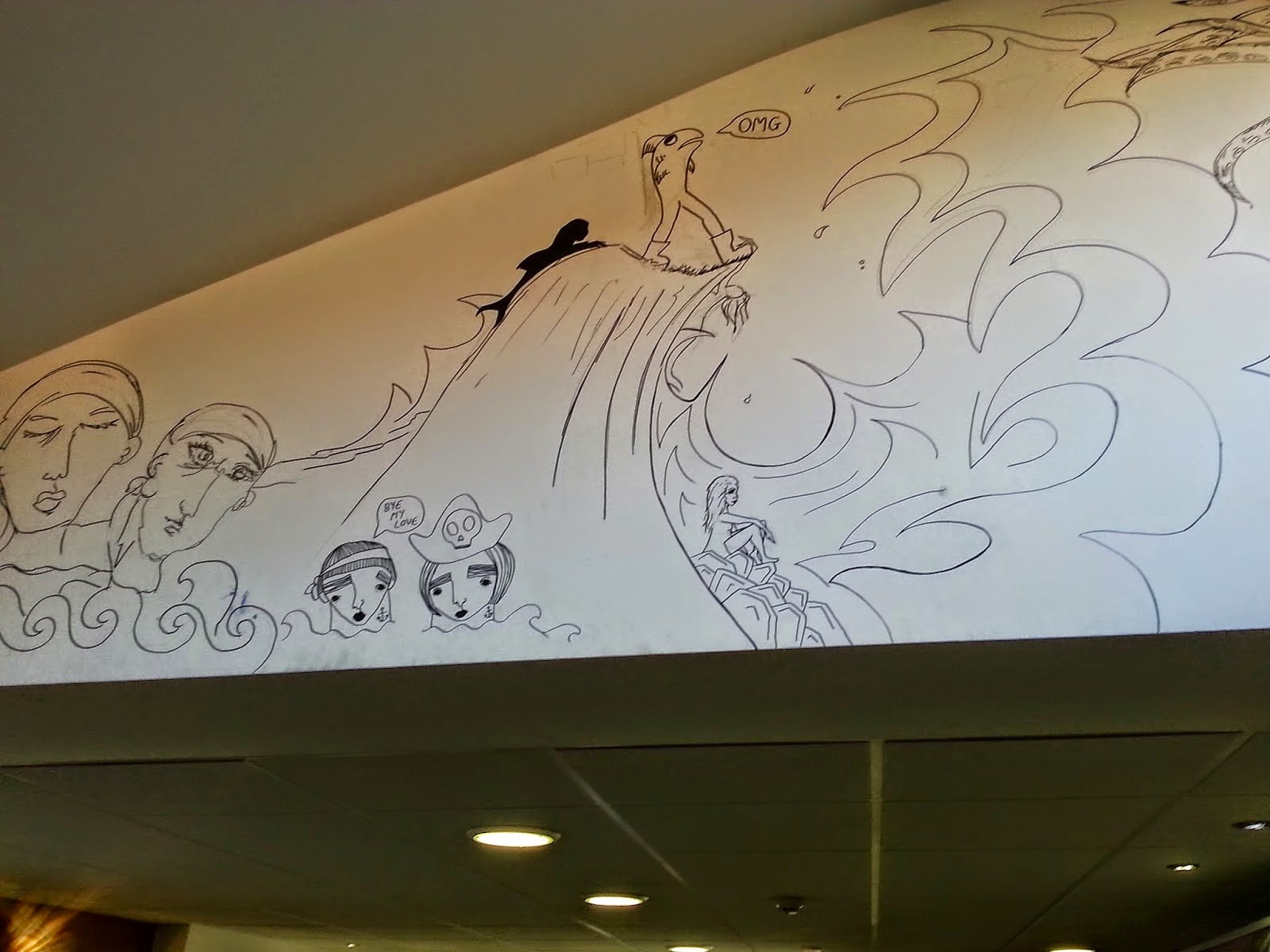
The fish designs turned out to be quite an important part of the finished piece because it was a small area of the wall where three of us (myself, Lucy and Carly) each combined our own illustrations in a sort of story. This described Lucys drawings of her own fish people slowly making the transition (in my drawings) into mermaids - designed by Carly.

Putting it all together

We each began sketching out our designs in our wall space using pens of different thicknesses and adding bits of colour in certain areas, like the bubbles. Everybody focussed on their own areas, but we all pulled together and assisted each other to make sure we got to where we needed to be on time. 

My own area of the installation:   

Pirate faces

The fish transition 

More

Jelly fish / more fish and bubbles


Lucy's work


Carly's work


Lauren's work


The underwater pirates


Kaths work


The completed installation


Printing in this project

For this project we had to provide a print on the installation which Lucy covered with her fish people designs:


However I practiced a printing technique myself earlier in the project, and experienced lino printing for the first time. I found it quite a difficult process but I think that it would be quite interesting to practice this technique further and learn more about how to craft with the lino and create more successful prints. Here was my attempt using blue ink:


Overall, I felt that this whole experience of working from a live brief and collaborating with my peers to take part in this exhibition was crucial and incredibly useful towards my practice and my potential future as an illustrator. It enabled me to get a taste of what it might be like to work collectively with others on an important project, and tested my personal strengths and weaknesses. I feel like this task helped me to gain a lot more experience and it was very helpful for our group to collaborate together due to us all being so different artistically. I was pushed far out of my comfort zone, but I now know that in the future I would be able to work on big projects with others much more confidently, and put forward my own ideas and contributions to the piece or body of work. In the future if I am ever in the position of working from a live brief again which is likely, I would most definitely try to manage my time better, and encourage my team to do so with me, perhaps working out strategies and plans for getting jobs done on time. This is due to our group being very close to missing our deadline which is not an option in this kind of project.